The best Amazon affiliate WordPress plugin is one that pulls prices from the PA API, refreshes them daily, and outputs light markup — AAWP, Lasso, AzonPress, Amazon Auto Links, AmaLinks Pro, or ThirstyAffiliates paired with a box builder.
How we compared
Product boxes fail in two predictable places. The price inside goes stale, or the script that renders the box delays the click. Every judgment below follows from those two failure points.
Six axes were applied to each plugin:
- Price data source — Product Advertising API (PA API), Creators API, or something else entirely.
- Refresh cadence — whether displayed prices update daily without you touching a post.
- Front-end weight — cached server-side markup versus live scripts firing on every box.
- Link handling — cloaking, geo-targeting, and what the box shows when an ASIN disappears.
- Editorial speed — how fast you can drop a box, table, or bestseller list into a draft.
- Cost per site per year — the only unit that makes a single-site license comparable to a multi-site bundle.
Google’s web.dev documentation states that Interaction to Next Paint passes only when at least 75% of interactions respond in under 200 milliseconds, a threshold that script-heavy product boxes can break.
Methodology. Checked: Amazon’s official Associates policy pages, each plugin’s public documentation and published pricing, and Google’s Core Web Vitals guidance. Not checked: nothing here was installed on a live site, so there are no first-party load times, no support response times, and no earnings comparisons. Feature sets change between releases, so confirm anything below in the vendor’s own docs before you pay.
| Plugin | Best for | Price unit to compare | Ask before you buy |
|---|---|---|---|
| AAWP | Amazon-only review sites | €79/year, single site (AAWP) | Does it cache markup or call PA API at render? |
| Lasso | Multi-network link and display management | Annual fee ÷ sites you run | How is the daily refresh timestamp shown? |
| AzonPress | Comparison-table roundups | Annual fee ÷ sites you run | What renders if your PA API keys throttle? |
| Amazon Auto Links | Monetizing a large archive cheaply | Free core, annual add-ons | Are auto-generated units editorially relevant? |
| AmaLinks Pro | Inline Amazon text and image links | Annual fee ÷ sites you run | Does it require your own PA API keys? |
| ThirstyAffiliates | Link hygiene across many networks | Annual fee ÷ sites you run | Does it display Amazon prices at all? |
What Amazon and the FTC actually require from an affiliate plugin
Compliance comes down to two questions: where the price came from, and how recently it was fetched.
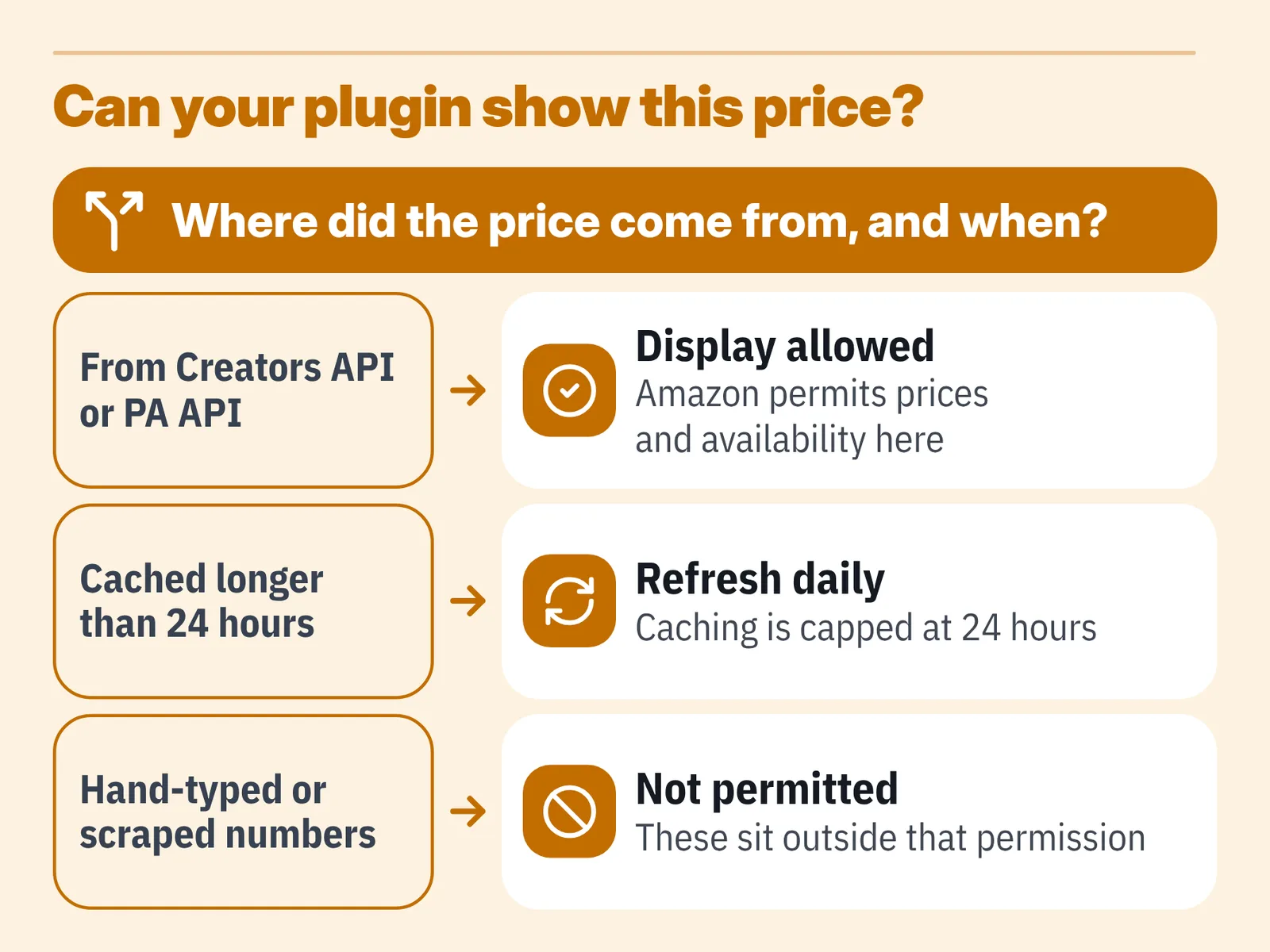
According to Amazon’s Associates Program Operating Agreement, non-image Product Advertising Content may be cached for only up to 24 hours, which is why compliant plugins refresh prices on a daily schedule. A plugin that writes a price into your post content once and leaves it there puts your account at risk.
Amazon’s Associates Program Policies permit a site to display prices and availability only when Amazon serves the link or the data comes from the Creators API or PA API, according to Associates Central. Hand-typed prices and scraped numbers sit outside that permission.
Disclosure is the other half. The Federal Trade Commission revised its Endorsement Guides in 2023, adding a new definition of "clearly and conspicuously" that applies to affiliate-link disclosures. A plugin helps only if its disclosure line appears near the links themselves, not buried in a footer.
The FTC guides cover advertisers and endorsers addressing US consumers; other countries run their own advertising rules, so a default disclosure string may not satisfy them. The same disclosure logic follows you off-site, including the rules around affiliate links inside TikTok videos. This is general information, not legal advice.
1. AAWP
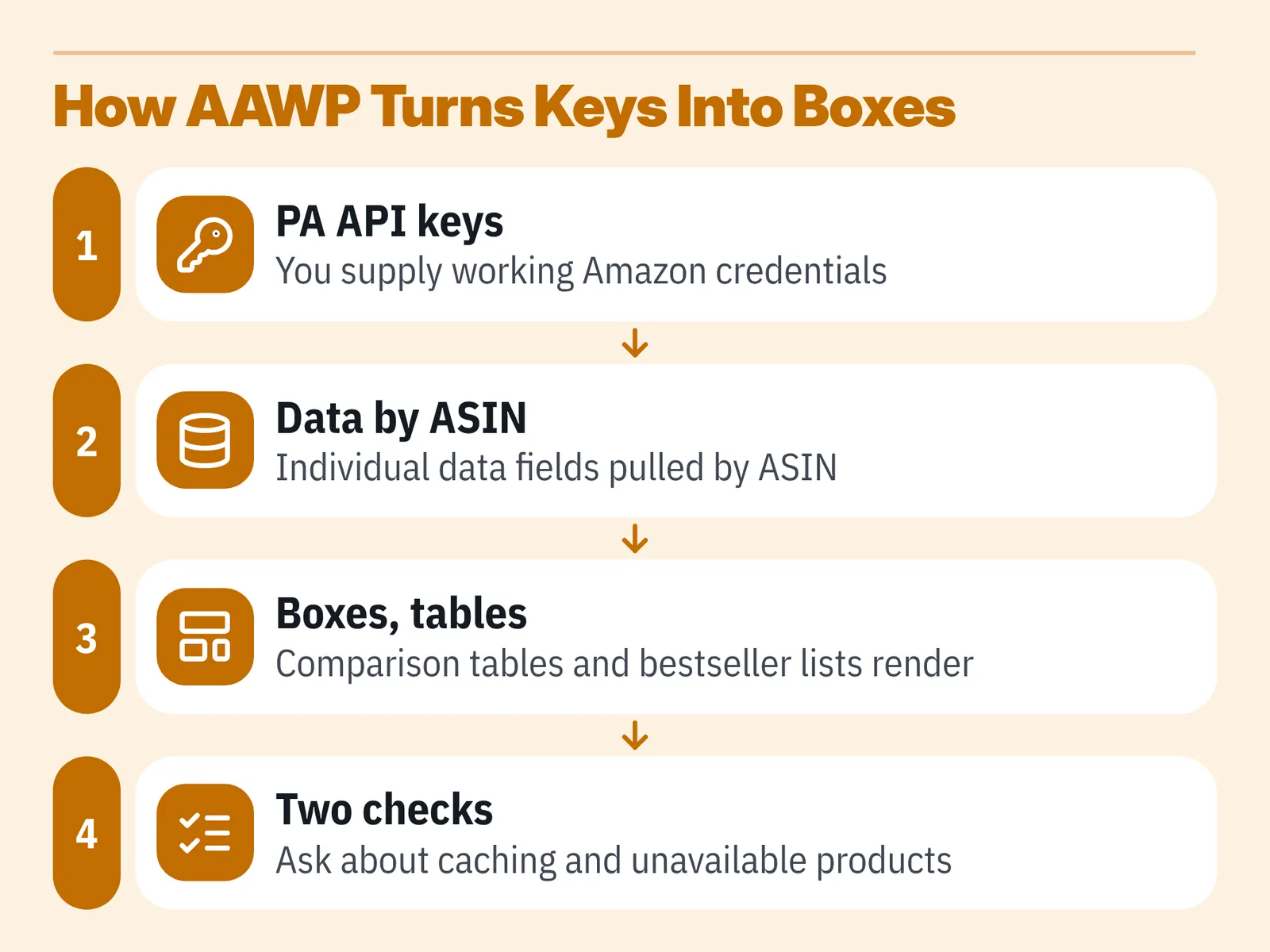
AAWP is the Amazon-only option that most established review sites end up evaluating first. Its product page documents boxes, comparison tables, bestseller lists, and individual data fields pulled by ASIN, all driven by PA API credentials you supply.
AAWP’s official pricing starts at €79 per year for a single site, including one year of updates and support, according to AAWP. On one site that figure is your whole cost per site per year; if you run several sites, divide the relevant license fee by the number of live sites before you compare it against anything else.
Two checks matter before you commit. Ask whether boxes render from cached HTML or hit the API on page load, and ask what the box outputs when a product is unavailable.
Best for: a focused Amazon review site where native-looking boxes and tables carry most of the revenue.
Skip it if: you cannot supply working PA API credentials, because an Amazon-data plugin without keys renders empty boxes.
2. Lasso
Lasso is the option that publishes its compliance position in writing, which is unusual in this category. Lasso’s own compliance documentation states that displayed Amazon prices must be updated at least every 24 hours, and the plugin refreshes them daily with a timestamp.
That timestamp is worth more than it looks. It gives you something visible to audit when you open an old roundup and wonder whether the numbers on screen are current.
Lasso is positioned as a link and display manager rather than an Amazon-only tool, so evaluate it against the full set of programs you monetize, not Amazon alone. Confirm how its boxes are rendered and how many sites a license covers, then convert that to cost per site per year.
Best for: creators running Amazon plus other networks who want one place to manage links and one documented refresh rule.
Skip it if: you run a single small Amazon site and will never use the multi-network side, since you would pay for reach you don’t need.
3. AzonPress
AzonPress sits in the table-first camp. Its documentation centers on Amazon comparison tables, product boxes, and list layouts built from ASINs, which suits "best X for Y" roundups more than single-product reviews.
Tables are also where speed problems hide. A ten-row comparison table can mean ten image requests and a wide block that reflows on mobile, so check whether output is server-rendered HTML and whether images are lazy-loaded.
Send the vendor three questions before buying: does it refresh via PA API on a daily schedule, does it cache markup or call the API at render time, and what appears when your API keys get throttled. Answers in writing beat marketing copy.
Best for: roundup-heavy sites where the comparison table is the conversion unit and individual boxes are secondary.
Skip it if: your content mixes several affiliate programs per post, since an Amazon-centric table builder forces awkward workarounds for non-Amazon rows.
4. Amazon Auto Links
Amazon Auto Links does what its name says: it generates Amazon link units automatically instead of asking you to hand-pick every ASIN. A free core plugin with paid add-ons makes it the cheapest entry point on this list.
Automation is the feature and the risk. Units built from category or search feeds can surface products you would never recommend, and a page full of auto-generated listings reads as thin to both readers and reviewers.
Use it where human curation is impractical — old archive posts, sidebar units, category pages — and keep hand-picked boxes in the reviews you actually want ranking. If budget is the constraint, pair it with the tactics in this guide to starting affiliate marketing with no money.
Best for: a large existing archive you want monetized quickly at near-zero software cost.
Skip it if: your traffic comes from genuine recommendations, because automated units dilute the editorial signal that earns those clicks.
5. AmaLinks Pro
AmaLinks Pro is Amazon-only and leans toward in-sentence linking as much as full boxes. Text links, image links, and showcase-style boxes are the formats its documentation emphasizes, which fits long reviews where products appear mid-paragraph.
Inline links carry a quiet advantage: they add almost nothing to page weight compared with a scripted box, so a review can hold a dozen of them without touching your interaction timings.
Confirm whether the plugin requires your own PA API keys, how often it refreshes prices, and whether any no-API display mode exists — and if one does, confirm that it never prints a price. Price display without Amazon-served data is exactly what the Associates policies rule out.
Best for: writers producing long Amazon-only reviews who want link variety rather than table machinery.
Skip it if: you plan to diversify beyond Amazon, in which case look at the trade-offs in this breakdown of Home Depot affiliate marketing and its alternatives.
6. ThirstyAffiliates
ThirstyAffiliates belongs to the link-management category rather than the product-box category. Cloaked URLs, link categories, bulk editing, and keyword auto-linking are the jobs it is marketed for, which matters once a site passes a few hundred outbound links.
The practical case for it is maintenance. When a merchant changes a destination or an ASIN dies, you edit one link record instead of combing through forty posts.
Pricing display is the limit. Amazon’s Associates Program Policies allow a site to show prices and availability only when Amazon serves the link or the data comes from the Creators API or PA API, so a link manager usually needs a box plugin beside it rather than replacing one. Verify in its docs what it does and does not render.
Best for: multi-program sites that need durable, renamable links across a large archive.
Skip it if: all you want is one Amazon price box per review and nothing else to maintain.
Which one fits you
| If this is you | Choose |
|---|---|
| One Amazon review site, boxes and tables drive revenue | AAWP |
| Amazon plus other networks, want a documented refresh rule | Lasso |
| Roundups where the comparison table converts | AzonPress |
| Big archive, minimal budget | Amazon Auto Links |
| Long Amazon-only reviews with inline links | AmaLinks Pro |
| Hundreds of links across programs | ThirstyAffiliates plus a box plugin |
The payback math depends on your category more than your plugin. In the US Standard Commission Income table, Luxury Beauty, Luxury Stores Beauty and Amazon Explore pay a fixed 10.00%, while Digital Music, Physical Music, Handmade and Digital Videos pay 5.00%, according to Amazon Associates Central. A license that pays for itself in a 10.00% category may never clear its cost in a 5.00% one.
Timing shapes design too. An Amazon affiliate session ends 24 hours after the click, or earlier if the customer orders or follows another Associate’s link, according to the Associates Program Operating Agreement. Your box exists to earn the click on the page, not to nurture a long window.
Pick the plugin after you pick the pages. Build boxes on posts chosen with buyer-intent affiliate keywords, then spend on software that keeps those specific prices fresh and those specific pages fast.
Frequently asked questions
Do I need PA API access to run an Amazon affiliate WordPress plugin?
For anything that shows a price, yes. Amazon’s Associates Program Policies permit displaying prices and availability only when Amazon serves the link or the data comes from the Creators API or PA API, so a plugin without credentials should output links and images only.
How often do Amazon prices have to refresh in a product box?
Daily. Amazon’s Associates Program Operating Agreement allows non-image Product Advertising Content to be cached for only up to 24 hours, which is why compliant plugins run a scheduled refresh and why Lasso’s documentation describes a daily update with a visible timestamp.
Will a product-box plugin hurt my Core Web Vitals?
It can, depending on how boxes render. Google’s web.dev documentation sets Interaction to Next Paint at under 200 milliseconds for at least 75% of interactions, so check whether your plugin outputs cached server-side HTML or loads scripts and images on every box.
Are free Amazon affiliate plugins compliant?
Free does not mean non-compliant, but it shifts the burden to you. Verify that the plugin refreshes prices within Amazon’s 24-hour caching limit, pulls data through an approved API, and never prints a hard-coded price into your post content.
Does any plugin handle FTC disclosure for me?
Several insert a disclosure line above boxes, but placement is your responsibility. The FTC revised its Endorsement Guides in 2023 with a new definition of "clearly and conspicuously" for affiliate disclosures, and those guides address advertisers and endorsers reaching US consumers; other countries apply their own rules. General information, not legal advice.
Sources
- Amazon.in Associates Central — Associates Program Operating Agreement
- Amazon.com Associates Central — Associates Program Policies
- Standard Commission Income Rates — Amazon Associates Central
- Is Lasso Compliant with the Amazon Associates Terms of Service? — Lasso Support
- AAWP — Amazon Affiliate WordPress Plugin
- Interaction to Next Paint is officially a Core Web Vital — web.dev
- FTC’s Endorsement Guides: What People Are Asking — Federal Trade Commission
Written with AI assistance and fact-checked against the sources cited above before the Amazon Affiliate Editorial Team published it.