Usually not as a primary program. Home Depot’s own affiliate FAQ lists 1% on products and a 1-day cookie, so it works best as a secondary link for décor posts and local-pickup readers.
Why home and DIY sites look beyond Amazon Associates
A tutorial on framing a basement wall sends readers shopping for lumber, fasteners, and a circular saw. One of those three monetizes cleanly through Amazon. The other two usually end with someone driving to a store.
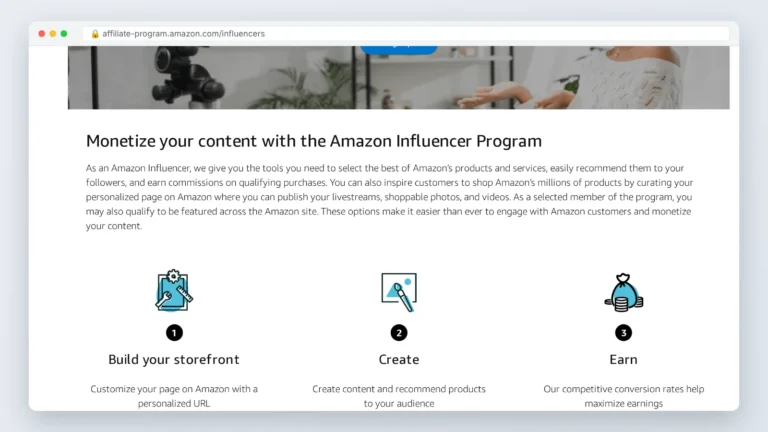
Amazon Associates’ standard commission rate for Home Improvement, Tools, Furniture, Home and Lawn & Garden products is a fixed 3.00%, according to the Amazon Associates Standard Commission Income Rates page. That single rate is why most DIY blogs start there. It is also why many start shopping around once traffic grows.
Placement matters too. Under Amazon’s Onsite Associates Program, direct qualifying purchases of Tools pay only 1.75%, versus 3.00% for Furniture, Home and Home Improvement, per Amazon’s Onsite Commission Income help page.
Three reader behaviors push home and DIY publishers toward retailer programs:
- Project shoppers who want material today, not in two days.
- Carts dominated by lumber, drywall, concrete, paint, or appliances.
- Seasonal décor and patio content, where retailer assortments beat marketplace listings.
None of that guarantees more revenue. Commission rate, conversion rate, and average cart size decide the outcome together, and a retailer program can lose on all three at once.
How the Home Depot affiliate program actually works: rates, cookie, and exclusions
The published terms matter far more than brand recognition here, and Home Depot publishes them plainly.
The Home Depot’s own affiliate FAQ states the program pays 1% on products, mobile and buy-online-pick-up-in-store orders, 1% on appliances, and 8% only on select home décor products. Home Depot’s affiliate cookie lasts just 1 day, meaning the order must be placed within 24 hours of the click to earn commission, according to the same FAQ.
The exclusion list shapes DIY content hardest. Home Depot excludes several common purchase types from affiliate commissions, including gift cards, installation services, custom products, select special orders and in-store purchases, per The Home Depot’s affiliate FAQ.
Two operational details before you apply:
- Home Depot requires applicants to already have a live, operating website at the time they apply, according to its affiliate FAQ.
- Home Depot’s affiliate payout threshold ranges from $50 to $100 depending on which payout method the affiliate selects, according to BloggingTips.
The route you join through changes the math as well. Joining through a sub-affiliate network can cut the rate: FlexOffers listed the payout as 0.8% of sales and 6.4% for HD Home products.
Run your own cart math against those numbers before touching a single link.

1. The Home Depot Affiliate Program
Best fit: décor-heavy home blogs, renovation diaries, and regional content where readers genuinely buy online for store pickup.
The program’s one strong tier is décor. Home Depot’s affiliate FAQ puts select home décor at 8% while products and appliances sit at 1%, so a styled-shelf post can out-earn a tool review by a wide margin on the same traffic.
Migration effort: low. There is no fee, you apply with a live site, and the work is swapping links in your ten highest-traffic posts and adding a retailer option beside existing Amazon links. Budget an afternoon per twenty posts, plus a quarterly link audit.
Where it hurts: the 24-hour window documented in Home Depot’s FAQ punishes research content. Someone reading your tile comparison on Tuesday and buying on Saturday earns you nothing.
The exclusions cut deeper than most publishers expect. Installation services and custom products are exactly what renovation readers buy, and both sit outside commissionable orders.
Treat it as a secondary link, not a replacement for your primary program.
2. Lowe’s Affiliate Program
Best fit: the same audience, with a slightly better base rate and a different exclusion problem.
The Lowe’s affiliate program pays a standard 2% commission and excludes categories such as gift cards and lumber, according to BloggingTips. Double the base rate Home Depot publishes on products, and a direct hit to deck, fence, and framing content.
Think about which posts actually drive your clicks. A site built on paint projects, storage builds, and appliance guides keeps most of its cart commissionable. A site built on lumber-heavy builds loses the largest line item in every project.
Migration effort: low, and nearly identical to Home Depot. Network application, deep links, same link-swap routine across your top posts.
Running both retailers is reasonable if your audience is geographically split. Offer two store options under each materials list and let the reader pick whichever is closer.
Watch your own data for two months before declaring a winner, since exclusions show up as missing revenue rather than missing clicks.
3. Wayfair Affiliate Program
Best fit: furniture, décor, nursery, outdoor living, and room-makeover content — not tools.
Wayfair’s affiliate program pays 5–7% on a 7-day cookie through CJ Affiliate, with an average order value around $300 that yields roughly $21 per sale at 7%, according to Afftank’s 2026 roundup of home décor and furniture affiliate programs. That cookie window alone changes which content types can convert.
Migration effort: medium. The program will not fit your drill comparison or your grout guide, so the move means commissioning or rewriting furnishing content rather than re-linking existing posts.
A practical sequence: pick three room-makeover posts already ranking, rebuild their product sections around furniture and lighting, and leave your tool posts alone.
The trade-off is seasonality and returns. Furniture carts are larger and slower, and reversals land weeks after the sale, so judge performance on a full quarter.
Higher rate, narrower catalog. That is the honest summary.
4. Target Affiliate Program
Best fit: home organization, cleaning, small kitchen appliances, and seasonal décor where readers already shop weekly.
No current Target rate card appears in the sources verified for this article, so pull the figure from the partner dashboard rather than trusting any blog’s published number, including older roundups.
Migration effort: low to medium. Application and approval are straightforward for an established site, link generation supports deep links to specific product pages, and most of the work is deciding which posts justify a second retailer button.
Where Target earns its place is cart composition. A reader buying storage bins often adds unrelated household items in the same order, and multi-item carts tend to lift effective earnings per click even when the headline rate is modest.
Where it fails is professional tools, lumber, and anything structural. Do not point a deck-building audience here.
Check exclusions carefully before you rewrite anything, since several household categories commonly sit outside commissionable orders.

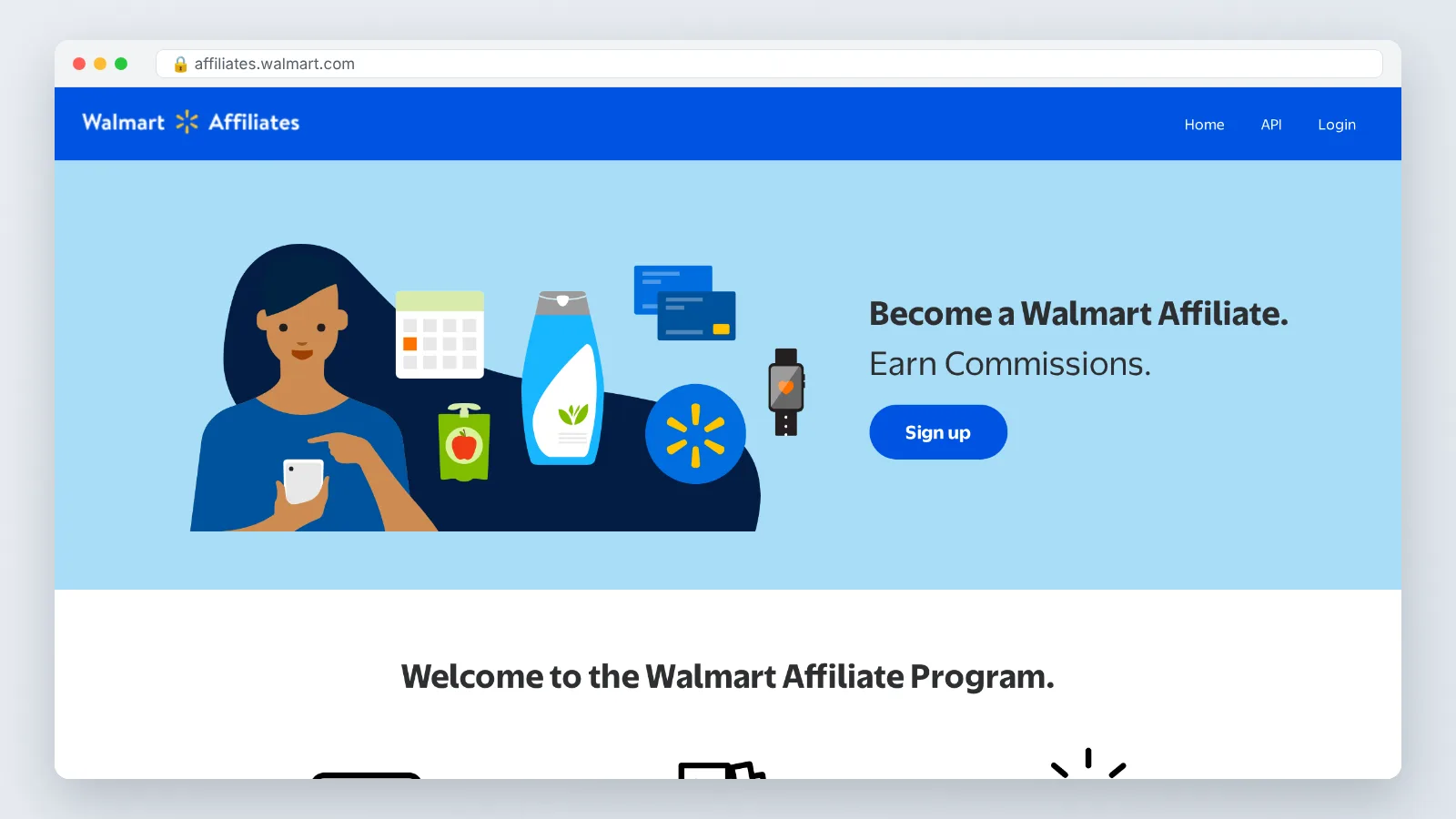
5. Walmart Affiliate Program
Best fit: budget build guides, cleaning and laundry content, garage organization, and gift roundups aimed at cost-conscious readers.
Walmart’s catalog overlaps home improvement, home goods, and grocery in a way the specialty retailers do not, which helps if your traffic skews toward cheap fixes rather than full renovations.
Rates vary by category, so verify the live rate card in the program dashboard before committing a post to it. Avoid quoting any number you cannot see on the current terms page.
Migration effort: low. Apply, generate deep links, and test on a handful of budget-focused posts where price is the deciding factor for your reader.
The realistic ceiling is low-rate, high-volume earnings. Say, an organizer at an illustrative price of $18 — not a sourced average — earns very little, so this program pays off through click volume rather than cart size.
Pair it with a higher-rate program on the same page when the product exists in both catalogs.
How the programs compare side by side
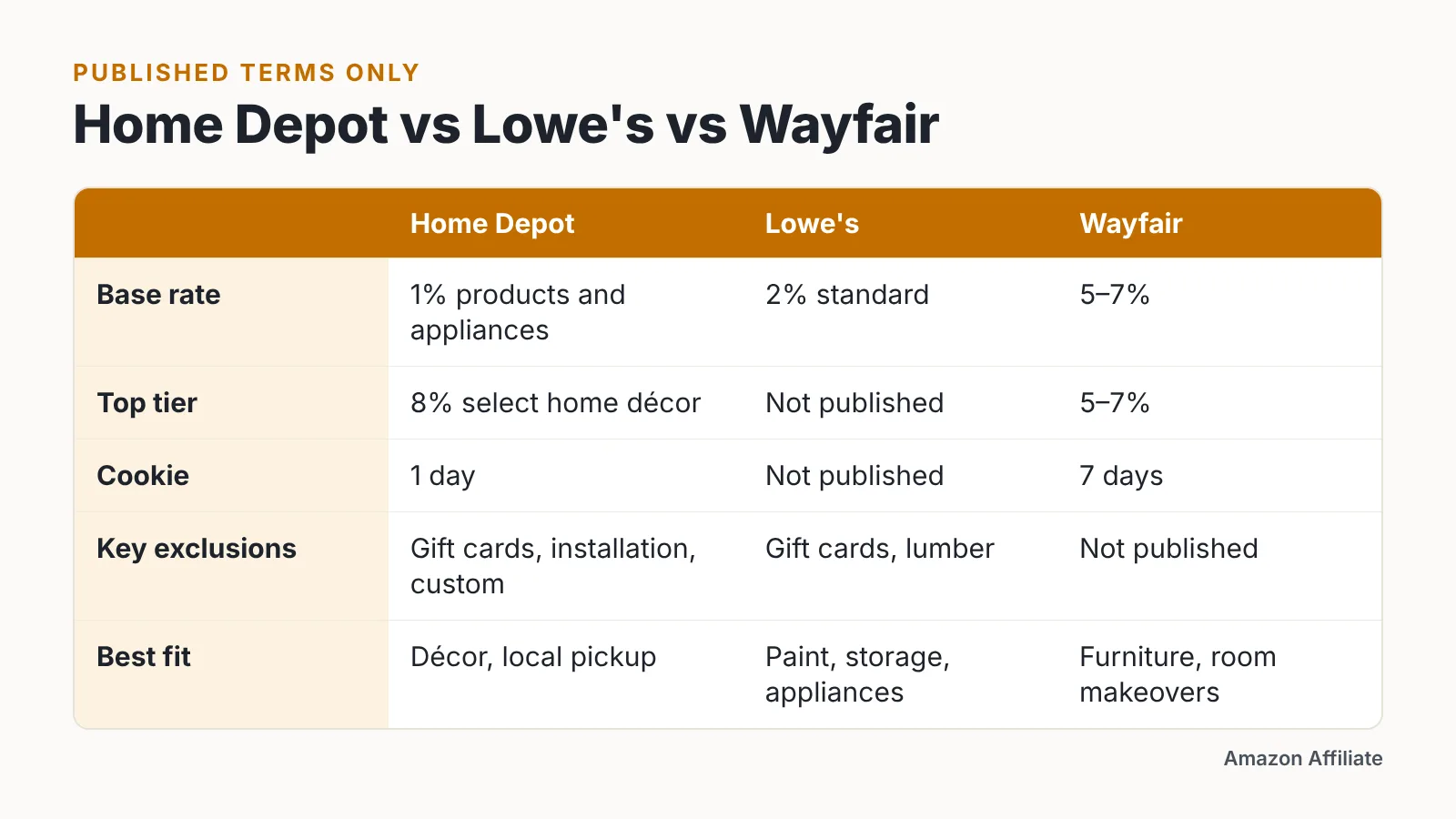
Read the table as a starting filter, not a verdict. Rate alone decides nothing, because a 24-hour cookie on a 1% product destroys the advantage a higher-volume retailer might have offered, and a 7-day window on furniture can quietly outperform everything else on the page.
Figures below appear only where a named source publishes them. Target and Walmart category rates are deliberately left blank rather than estimated. All terms described here are the US versions of these programs; Home Depot, Lowe’s, Target and Walmart terms differ by country.
| Program | Published rate | Cookie | Known exclusions | Migration effort |
|---|---|---|---|---|
| Amazon Associates (baseline) | 3.00% standard for Home Improvement, Tools, Furniture, Home, Lawn & Garden; 1.75% for Tools under Onsite Associates (Amazon) | Not in sources | Not in sources | None |
| Home Depot | 1% products, 1% appliances, 8% select décor (Home Depot FAQ) | 1 day (Home Depot FAQ) | Gift cards, installation, custom products, select special orders, in-store (Home Depot FAQ) | Low |
| Lowe’s | 2% standard (BloggingTips) | Not in sources | Gift cards, lumber (BloggingTips) | Low |
| Wayfair | 5–7% via CJ Affiliate (Afftank) | 7 days (Afftank) | Not in sources | Medium |
| Target | Category-based; verify in dashboard | Not in sources | Not in sources | Low–medium |
| Walmart | Category-based; verify in dashboard | Not in sources | Not in sources | Low |
One more cost line worth planning for: Home Depot’s affiliate payout threshold ranges from $50 to $100 depending on payout method, according to BloggingTips, so early earnings sit unpaid for a while.
When to stay with the original
Keep Amazon Associates as your primary program if your top ten posts are tool reviews, gadget comparisons, or low-ticket buying guides. The gap is structural, not marginal.
Amazon Associates’ standard rate for Home Improvement, Tools, Furniture, Home and Lawn & Garden products is a fixed 3.00%, per Amazon’s rate page, while Home Depot’s FAQ lists 1% on products and appliances. Three times the rate on the same click is hard to argue with.
The cookie reinforces it. A 1-day window, as documented in Home Depot’s affiliate FAQ, means your evergreen comparison posts only earn from same-day buyers.
Stay put in three more cases:
- Your audience is international and Amazon’s locale redirection handles it.
- Your content is research-heavy, with long gaps between reading and buying.
- Your team cannot maintain two sets of links without breaking them.
Add a retailer program when you have a specific, measurable reason — a décor series, a local-pickup audience, or a furniture category Amazon serves poorly. Chasing a second program for variety alone usually costs more in link maintenance than it returns.
How we checked this
Rates, cookie duration, exclusions, and the live-website requirement come from The Home Depot’s published affiliate FAQ page. Amazon’s standard and Onsite commission figures come from Amazon Associates help documentation. Lowe’s rate and exclusions and Home Depot’s payout threshold come from BloggingTips; the sub-affiliate rate comes from FlexOffers’ Home Depot program listing; Wayfair’s rate, cookie, and average order value come from Afftank’s 2026 home décor and furniture roundup.
What we could not verify: current Target and Walmart category rates, EPC figures for any of these programs, approval rates, reversal rates, or whether negotiated rates exist for large publishers. Nothing here was tested hands-on, and no affiliate dashboards were accessed.
Program terms change without notice. Confirm every rate and exclusion in the program’s own dashboard before rewriting links across a site.
This is general information about affiliate program terms, not legal or financial advice.
Frequently asked questions
Is Home Depot affiliate marketing better than Amazon for tool content?
No. Amazon Associates’ standard rate for Home Improvement, Tools, Furniture, Home and Lawn & Garden is a fixed 3.00% per Amazon’s rate page, while The Home Depot’s affiliate FAQ lists 1% on products and appliances. Home Depot only wins on select décor.
How long does the Home Depot affiliate cookie last?
Home Depot’s affiliate cookie lasts just 1 day, meaning the order must be placed within 24 hours of the click to earn commission, according to The Home Depot’s affiliate FAQ. That short window makes the program a poor fit for research-heavy comparison posts.
Which Home Depot purchases earn no affiliate commission?
Home Depot excludes several common purchase types from affiliate commissions, including gift cards, installation services, custom products, select special orders and in-store purchases, per its affiliate FAQ. Renovation audiences buy installation and custom products often, so model that loss before switching.
Do I need a website before applying to the Home Depot affiliate program?
Yes. Home Depot requires applicants to already have a live, operating website at the time they apply, according to its affiliate FAQ. Plan for payouts too: BloggingTips reports a payout threshold ranging from $50 to $100 depending on the method you select.
Should I join Home Depot through a sub-affiliate network?
Only if the network gives you access you cannot get directly. Joining through a sub-affiliate network can cut the rate: FlexOffers listed the payout as 0.8% of sales and 6.4% for HD Home products, below the direct rates in Home Depot’s own FAQ.
Sources
- Affiliate Program FAQs – The Home Depot
- Home Depot Affiliate Programs, Payment Details, & More — BloggingTips
- The Home Depot Affiliate Program – FlexOffers.com
- Standard Commission Income Rates — Amazon Associates
- Onsite Commission Income / Direct Qualifying Purchases — Amazon Associates
- How The Lowe’s Affiliate Program Works For 2024 — BloggingTips
- 20 Best Home Decor & Furniture Affiliate Programs 2026 — Afftank
Written with AI assistance and fact-checked against the sources cited above before the Amazon Affiliate Editorial Team published it.