B2B affiliate marketing pays you for referring businesses to software and services, usually as recurring percentage commission on a long sales cycle with a committee of buyers — not a one-time cut of a single shopper’s checkout.
What B2B affiliate marketing actually is (and why the buyer changes everything)
B2B affiliate marketing means you earn commission for sending a business to something it buys on a company card: a CRM, a help desk, payroll software, hosting, a bookkeeping service. Nothing ships in a box. The purchase gets provisioned, onboarded, and renewed every month until somebody cancels it.
The buyer, not the product, changes the economics. Complex B2B purchases typically involve 6 to 10 decision-makers, according to Gartner research cited in the guide "How B2B Companies Make Buying Decisions (Complete Guide)," so your article gets forwarded to a founder, argued over in Slack, and revisited after a budget meeting.
That forwarding behavior is exactly why B2B programs pay the way they do. A shopper can pick a kettle in a single sitting and never think about it again. An agency spends weeks choosing a CRM, migrates its contact database, trains four people, and then stays for years because leaving is painful.
So your reader is not "a consumer with a problem." Your reader is an operations lead who has to defend a recurring line item to someone who did not read your post. Write for the forward, not the click.
B2B vs. consumer affiliate programs: the six structural differences that matter to your payout
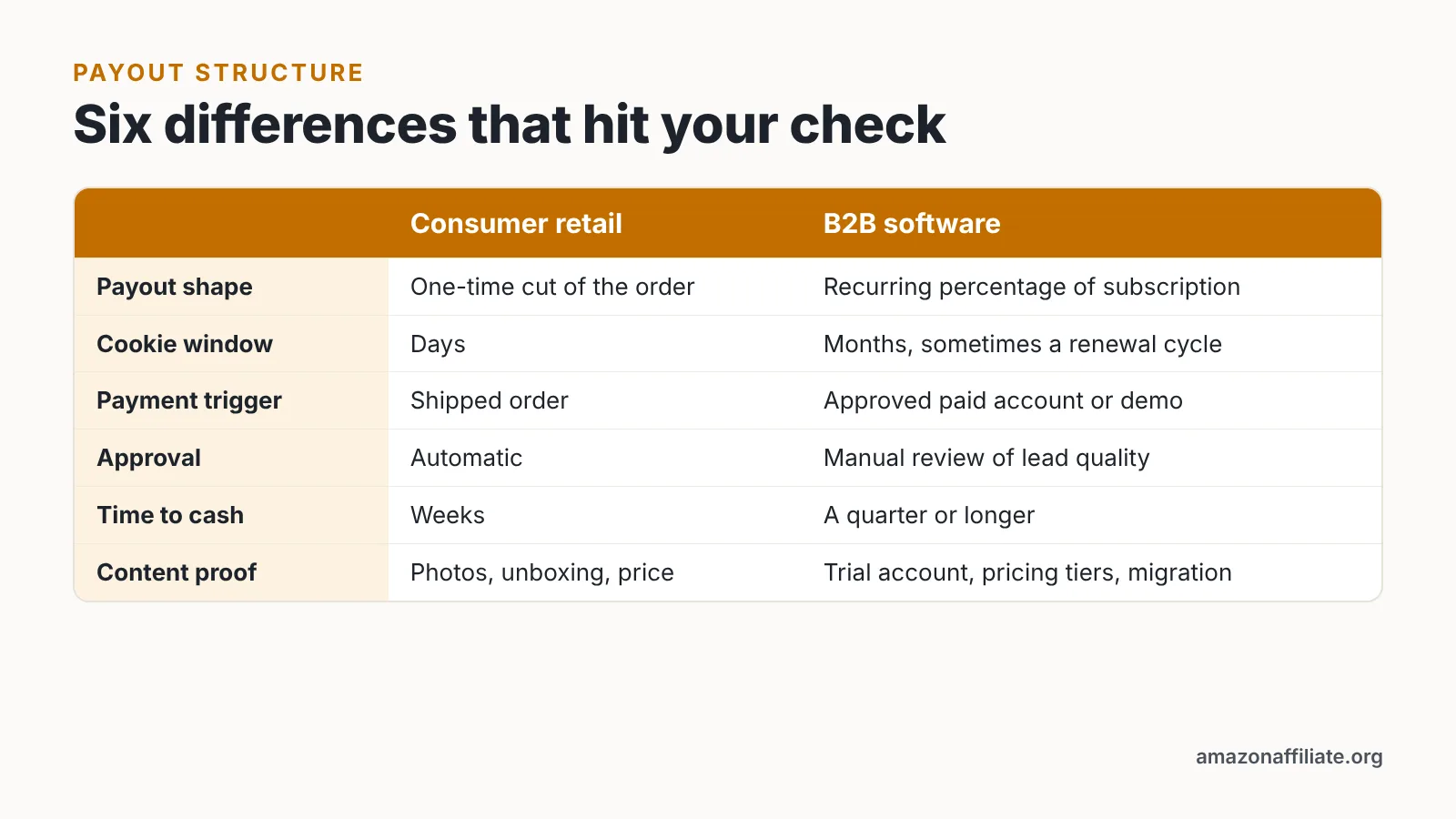
Six structural differences separate a business software program from a consumer retail one, and every one of them hits your check.
| # | Difference | Consumer retail program | B2B software or service program |
|---|---|---|---|
| 1 | Payout shape | One-time cut of the order | Recurring percentage of subscription revenue |
| 2 | Cookie window | Days | Months, sometimes a full renewal cycle |
| 3 | Payment trigger | Shipped order | Approved paid account, sometimes a qualified demo first |
| 4 | Approval | Automatic | Manual review of lead quality and traffic source |
| 5 | Time to cash | Weeks | A quarter or longer, after trial and refund windows close |
| 6 | Content proof | Photos, unboxing, price | Trial account, pricing tier mapping, migration notes |
Median affiliate commission is higher for B2B SaaS at 20% than for B2C SaaS at 15%, with ecommerce lower still, according to TrackRev’s 2026 SaaS affiliate program benchmarks. The highest fixed standard commission rate in Amazon’s US Associates rate table is 10.00%, for Luxury Beauty, Luxury Stores Beauty and Amazon Explore, according to Amazon Associates.
Rate alone does not decide which is better for you. A generous percentage on a cheap plan that churns by the second invoice can lose to a smaller percentage on a large one-time order, and a slow B2B payout still beats a fast one that never recurs.
The use case: turning one "best CRM for a 6-person agency" post into recurring commission
Picture a post you already have: a roundup of CRMs aimed at small marketing agencies, monetized with display ads and a couple of Amazon links to desk accessories. It ranks for a handful of long-tail queries. It earns pennies per session.
Rewrite it around one buyer with one constraint — a six-person agency with a shared inbox, no sales ops hire, and a founder who approves spend. Name the stack it has to connect to. Say which plan tier the team actually needs and which one is overkill.
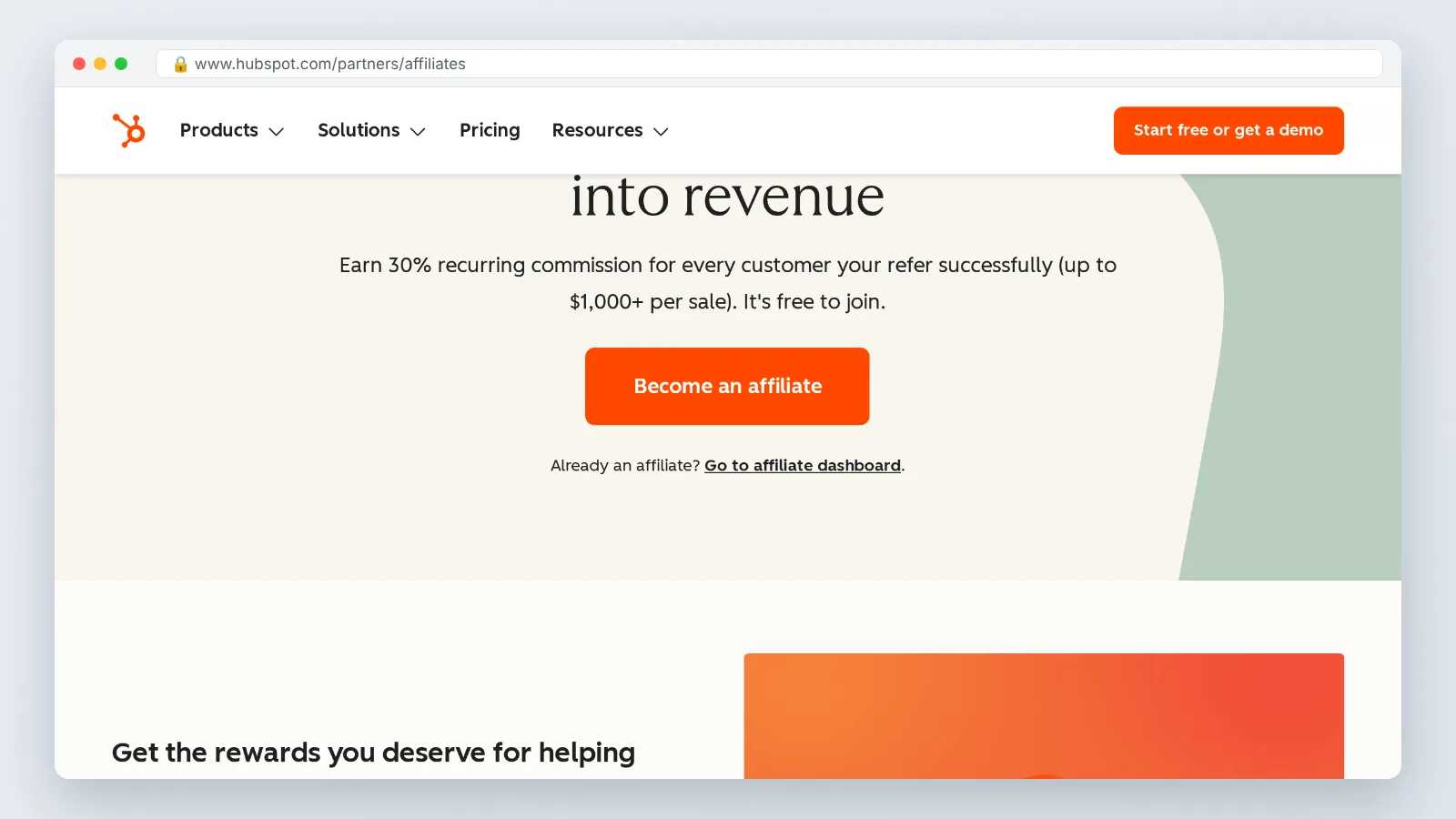
Then swap the monetization. HubSpot’s affiliate program pays 30% monthly recurring commission for up to one year and uses a 180-day cookie window, according to HubSpot’s affiliate program page, so a reader who bookmarks your comparison in March and buys in July still counts.
The ceiling moves with it. A single successful HubSpot referral can be worth more than $1,000 to the affiliate, according to HubSpot’s affiliate program page — a figure a desk-accessory link will never reach.
Add the assets that committee buyers ask for: a short "who should not buy this" section, a migration checklist, and an honest note about what breaks when the team grows past a shared inbox.
Before and after: how the content workflow changes when you swap product reviews for software referrals
Before, your production loop runs on physical goods. You order the item, shoot photos, test it for a week, check competitor pricing, publish, and refresh the post when the model number changes or Prime Day arrives.
After, the loop runs on access and accuracy. You open a free trial, build a realistic test workspace, map each pricing tier to a team size, document the import process, and record what the sales call actually asks you.
The payout profile flips in the same move. Amazon’s highest fixed standard commission rate in the US rate table is 10.00%, paid once, for Luxury Beauty, Luxury Stores Beauty and Amazon Explore, according to Amazon Associates; HubSpot’s program pays 30% monthly recurring for up to one year, according to HubSpot.
Your update cadence changes too. Product reviews age when hardware is discontinued. Software posts age when a vendor moves a feature behind a higher tier, which can happen quietly in any quarter — so put a calendar reminder on every B2B post, not just the top earners.
Reporting changes last. Clicks stop being the number you watch; approved accounts and refund-adjusted revenue take over, and you will wait longer to learn whether a post worked.
The reproducible procedure: a 7-step launch checklist for your first B2B affiliate offer
Run these seven steps in order. Skipping step three is a common way writers end up promoting a program that never approves their leads.
- Pick one buyer, not one category. "Six-person creative agency" beats "small business" because you can name the tools it already runs.
- Audit existing traffic. Find the posts where that buyer already lands, even if they currently monetize with physical products.
- Read three programs’ terms before applying. Check cookie length, recurring duration, approval criteria, clawback language, and whether paid search on brand terms is banned.
- Apply with a content plan attached. B2B programs screen applicants; a short note naming your target reader and two planned articles gets you through faster than a bare form.
- Build the evidence base. Open the trial, populate a test workspace, screenshot nothing you cannot explain, and note every limit you hit.
- Publish one decision-shaped post. Scenario in the title, comparison table, disqualifiers, pricing tiers mapped to team size, and a clear affiliate disclosure near the top.
- Reconcile after the refund window. Compare clicks, approved accounts, and paid commission once the vendor’s return and trial periods have closed.
Once that cycle is complete, repeat steps five through seven for the second program before adding a third. Two well-documented offers out-earn eight signup links.
Attribution reality check: cookie windows, lead approval, refunds and clawbacks
A long cookie is a promise about tracking, not about payment. HubSpot’s affiliate program uses a 180-day cookie window and pays 30% monthly recurring commission for up to one year, according to HubSpot’s affiliate program page, yet a referral still has to survive the vendor’s own approval step.
Three things eat B2B commissions after the click. Lead rejection, when the vendor decides the signup was an existing customer, a competitor, or a junk email. Refunds inside the guarantee period. Clawbacks when a subscription cancels during the chargeback window.
Last-click attribution causes the fourth leak. If a reader finds your comparison, then visits a coupon site before checkout, the coupon site usually takes the credit — which is why B2B programs that ban coupon placements protect content affiliates like you.
Keep your own ledger: date, post, program, clicks, signups, approvals, and reversals. Vendor dashboards restate numbers retroactively, and you want to notice when they do.
US affiliates are covered by the Federal Trade Commission’s endorsement guides, which require clear and conspicuous disclosure of a material connection; disclosure rules differ outside the United States, so check your own jurisdiction. This is general information, not legal advice.
How to vet a B2B program before you write a word (benchmarks and red flags)
Use published benchmarks as your reference point instead of the program’s marketing page. The average commission rate chosen by SaaS affiliate program managers is 24.16%, according to Rewardful’s platform data, so a 5% offer on a subscription product is below the norm and needs a reason.
Structure matters as much as rate. Across the SaaS affiliate programs measured in Rewardful’s platform data, 96.4% of commissions are calculated as a percentage of the sale rather than as a flat fee, which makes a small flat bounty on an enterprise plan a signal worth questioning.
Green flags
- Recurring commission with a stated duration, not "lifetime" with no terms
- Cookie window written in the agreement, not just the landing page
- A named partner manager who answers email within a few business days
- Public documentation of what counts as an invalid lead
Red flags
- Approval criteria described only as "at our discretion"
- Payment thresholds you would need a year to reach
- No self-serve plan, so every referral depends on the vendor’s sales team closing
- Terms that let the vendor change rates retroactively on existing referrals
Ask one blunt question before signing: what percentage of referred signups get approved? A program that will not answer is telling you the answer.
When to keep Amazon Associates in the mix alongside B2B offers
Dropping Amazon because software pays more is a mistake if your audience still buys physical things. The same agency owner choosing a CRM also buys monitors, chairs, label printers, and conference-room gear, and those purchases close the same day they are considered.
Amazon’s role is coverage and speed. The highest fixed standard commission rate in Amazon’s US Associates rate table is 10.00%, for Luxury Beauty, Luxury Stores Beauty and Amazon Explore, according to Amazon Associates — modest, but paid on a huge catalog with a checkout your reader already trusts.
A practical split looks like this. Software and service posts carry B2B links with recurring terms. Equipment, supplies, and "what we use" pages carry Amazon links. Hybrid posts — a home-office setup guide for a remote team — carry both, placed where the intent actually sits.
Keep the cash-flow difference in view while you build. Amazon pays steadily on small amounts; B2B pays late and unevenly, then compounds. Running both means your slow quarter on approvals does not become a slow quarter on income.

Key takeaways
- The buyer, not the product, drives the difference: complex B2B purchases typically involve 6 to 10 decision-makers, according to Gartner research cited in "How B2B Companies Make Buying Decisions (Complete Guide)."
- B2B structures pay more over time: HubSpot’s program pays 30% monthly recurring for up to one year with a 180-day cookie window, and a single successful referral can be worth more than $1,000 to the affiliate, according to HubSpot’s affiliate program page.
- Benchmarks beat marketing pages: median commission is 20% for B2B SaaS versus 15% for B2C SaaS, per TrackRev’s 2026 benchmarks, and SaaS program managers choose an average rate of 24.16%, per Rewardful’s platform data.
- Amazon still has a job: its highest fixed standard US rate is 10.00%, for Luxury Beauty, Luxury Stores Beauty and Amazon Explore, according to Amazon Associates — paid once, but fast and on a huge catalog.
- Run the seven-step checklist in order, then reconcile only after the refund window closes.
Frequently asked questions
How does B2B affiliate marketing differ from consumer affiliate programs?
B2B programs pay recurring percentages on subscriptions, use longer cookie windows, and require lead approval before payout. Consumer retail programs pay once per shipped order. HubSpot, for example, pays 30% monthly recurring for up to one year with a 180-day cookie window, according to its affiliate program page.
Is B2B affiliate marketing worth it if my blog gets modest traffic?
It can be, because per-referral value is far higher. A single successful HubSpot referral can be worth more than $1,000 to the affiliate, according to HubSpot’s affiliate program page, so a few qualified business readers per month can out-earn thousands of casual shoppers clicking low-rate retail links.
What commission rate should I expect from a B2B software program?
Use published benchmarks as your anchor. The average commission rate chosen by SaaS affiliate program managers is 24.16%, according to Rewardful’s platform data, and median commission is 20% for B2B SaaS versus 15% for B2C SaaS, according to TrackRev’s 2026 benchmarks.
Why do B2B affiliate payouts take so long to arrive?
Three delays stack up: the sales cycle, the vendor’s lead approval review, and the refund or chargeback window. Complex B2B purchases typically involve 6 to 10 decision-makers, according to Gartner research cited in "How B2B Companies Make Buying Decisions (Complete Guide)," so expect a quarter or more between the click and confirmed, non-reversible commission.
Should I drop Amazon Associates once I add B2B offers?
No. Keep Amazon for physical goods your business readers still buy — monitors, chairs, office supplies — where purchases close the same day. Amazon’s highest fixed standard US commission rate is 10.00%, for Luxury Beauty, Luxury Stores Beauty and Amazon Explore, according to Amazon Associates.
Sources
Written with AI assistance and fact-checked against the sources cited above before the Amazon Affiliate Editorial Team published it.