No — if you are asking can i get affiliate earning buying for myself on amazon, Amazon’s Participation Requirements, which form part of the Operating Agreement, bar affiliates from artificially increasing their advertising fees by purchasing products themselves or encouraging others to buy through their links.
What "Earning Affiliate Commission on Your Own Amazon Purchases" Actually Means
Definition: Self-referral means clicking your own Amazon Associates link and buying the item yourself, expecting the advertising fee back as a private discount. Amazon’s help pages call these personal orders, and its program terms prohibit using your own purchases to inflate your fees.
The mechanics look harmless from a distance. Your tracking ID rides in the link as a tag parameter, checkout runs exactly as it would for any shopper, and the order can appear in your Associates reporting like a normal sale. Showing up in a report is not the same as being paid.
Amazon addresses personal orders at more than one point in the account lifecycle. The Amazon Associates Central help page on the application review process states that personal orders do not qualify as the qualifying sales needed to get an account approved.
Temptation scales with basket size. A countertop blender is one thing; a mattress, a camera body or a full home-office refresh makes the "I’ll just refer myself" math look serious enough to risk a program account on.
Self-referral is also different from the honest case where a reader buys a product you already own and reviewed. The item is identical. The buyer is not.
The Short Answer: Amazon’s Self-Referral Rule in the Operating Agreement
The answer is no, and it sits in the contract you accepted at sign-up. The Amazon Associates Program Participation Requirements, which form part of the Operating Agreement, explicitly bar affiliates from artificially increasing their advertising fees by purchasing products themselves or encouraging others to purchase through their links.
Scope matters. That rule governs participants in Amazon’s Associates Program under the agreement they signed, and each marketplace publishes its own version, so an account registered on amazon.co.uk, amazon.de or amazon.ca is bound by that locale’s agreement rather than the US one. The ban on self-purchase is the common thread across them.
The program’s entry requirements point the same direction. Amazon’s Associates Program Policies on Amazon.co.uk Associates Central require an applicant’s site to contain original content and be publicly available at the address given in the application.
Amazon’s published remedies here are contractual rather than criminal, and the Participation Requirements quoted above describe the conduct that breaches the agreement rather than a tariff of penalties. Reversed fees, withheld balances and closed accounts are outcomes this article treats as realistic, not clauses quoted from the contract — this is general information, not legal advice. Read the agreement for your own marketplace rather than trusting a forum post that says "small orders are fine."
How Amazon Tracking Works in Three Stages: Click, 24-Hour Cookie, Qualifying Purchase
Understanding the plumbing explains why the fee never arrives cleanly on a self-purchase.
- Click. Someone clicks a link carrying your store ID. Amazon records the click and drops a tracking cookie in that browser.
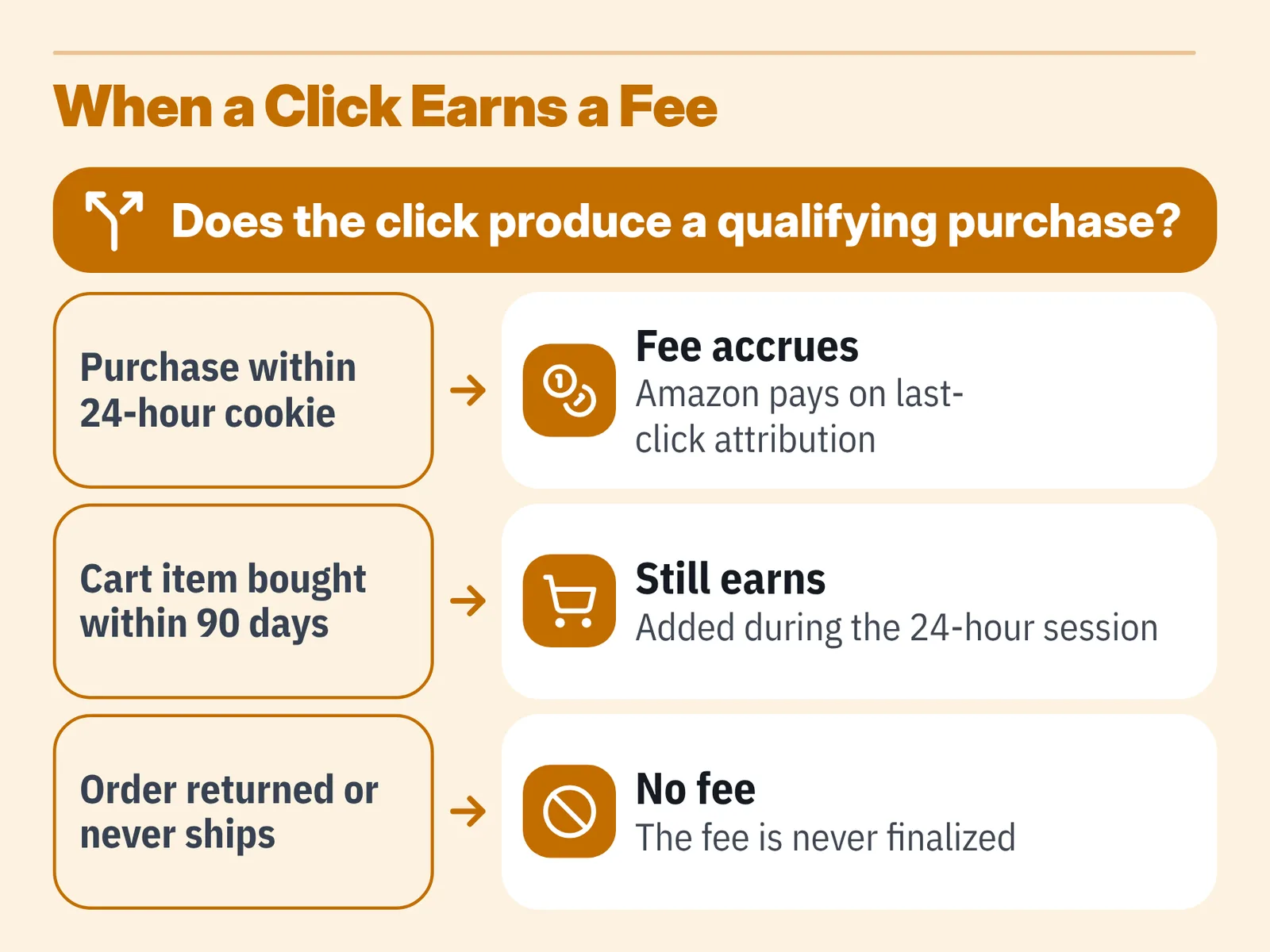
- Cookie window. Geniuslink reports that Amazon Associates pays on a last-click attribution model with a 24-hour (or first-purchase) cookie window, so commissions only accrue on purchases made shortly after a genuine referral click.
- Qualifying purchase. The order has to ship and stay unreturned before the fee is finalized, and Gaurav Tiwari notes that an item added to the cart during the 24-hour session can still earn a commission if it is bought from that cart within 90 days.
Amazon sits on both sides of that chain: it records the referral click and it processes the resulting order. None of the sources cited here describe how Amazon reviews or detects self-referrals, so treat the obvious inference — that a company holding both halves of a transaction is well placed to connect them — as inference, not published policy.
Traffic from strangers is the only input the model rewards. Pages built around search phrases that signal buying intent pull in those clicks; your own browser never will.
What Counts as a "Personal Order" (You, Family, Same Household, Your Own Devices)
Amazon’s help pages use the term personal orders, and the published text cited here does not spell out how far it reaches into families or households. That gap is not permission. In practice, treat all of the following as risky:
- Anything bought from your own Amazon account, whatever card pays for it.
- Orders placed by a spouse, parent, child or roommate who shares your address or Amazon Household.
- Purchases you place on someone else’s behalf from your device and are reimbursed for.
- A friend who clicks your link for a product they were not going to buy, with money quietly moved back to them afterward.
- Any second Amazon account you control, however it is named.
The gray zone is real. A sibling in another city who genuinely wanted the headphones you reviewed is a referral; the same sibling buying a monitor you asked for, then handing it to you, is not.
Use a plain test before you click. Would this purchase have happened without the arrangement, and would you be comfortable showing Amazon the full chain of who paid, who received and who benefited?
Self-Referral vs. Cashback and Card Rewards: The Legal Way to Save on Your Own Buys
People conflate three different money flows. Affiliate fees come from Amazon to a publisher for sending a shopper; cashback and card rewards come from a third party to a buyer for using their service.
| Route | Who pays you | Allowed on your own order? |
|---|---|---|
| Amazon Associates link | Amazon, as an advertising fee | No — barred by the Participation Requirements |
| Cashback or rewards portal | The portal, from its own commission | Depends on that portal’s terms — read them |
| Credit card rewards | Your card issuer | Yes — unrelated to Amazon’s affiliate agreement |
| Amazon coupons, deals, Subscribe & Save | Amazon, as a customer discount | Yes — a shopper offer, not a fee |
The fantasy number is worth naming. Amazon’s published US Standard Commissions Schedule sets a fixed rate of 12.00% for the Beauty, Watches, Jewelry and Luxury Beauty category — rates differ by marketplace — and that is the kind of figure that makes self-buying a watch feel clever.
The swap costs you little. Card rewards and retailer coupons stack on the same order without touching your Associates standing, while the fee route risks the account that pays you every month. If you are still weighing which parts of this business are above board, the piece on how to tell a real affiliate program from a scam covers the same instinct applied to networks.
What Happens If You Buy Through Your Own Links: Withheld Fees and Account Closure
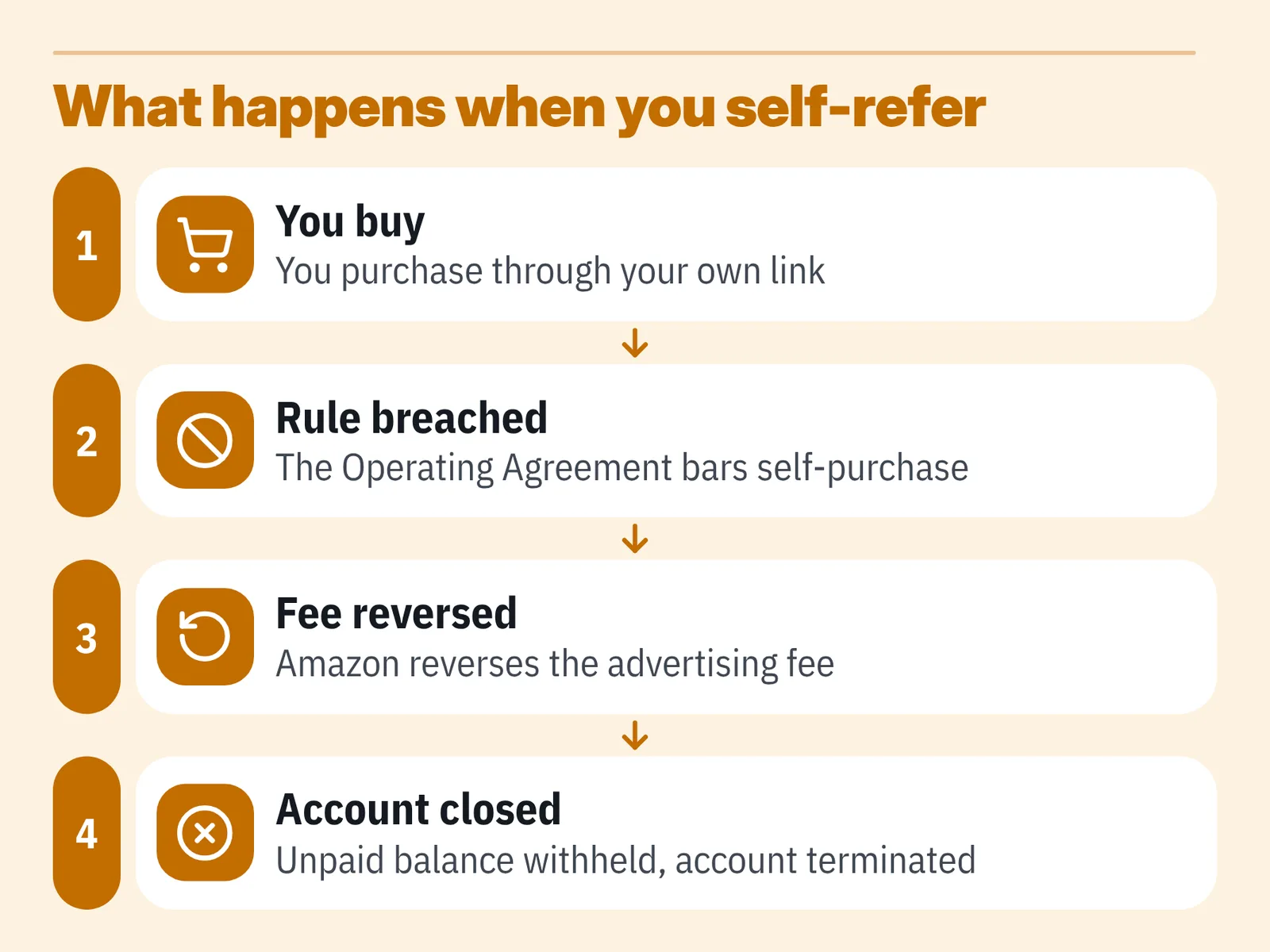
The sources cited here do not publish a step-by-step enforcement procedure. What the Participation Requirements establish is the breach itself: you buy through your own link, and the rule against inflating your own fees is broken. From there, the consequences this article treats as realistic — reversal of the fee on the flagged order, a withheld unpaid balance, and, at the far end, a closed account — are its own reading rather than quoted contract terms.
New accounts fail faster. PA-API Plugin reports that Amazon gives a new Associates application 180 days from the sign-up date to refer at least three qualifying sales, and an affiliate’s own purchases do not count toward that total.
A closure takes more than the fee with it. You lose Product Advertising API access, your SiteStripe links stop converting, and every page you built on those links needs new monetization at once.
Rejoining is possible but not automatic. Amazon can refuse a reapplication from a terminated participant, and creating a fresh account to dodge a termination is itself a breach of the agreement you would be re-signing.
The honest cost comparison is simple. One self-referred order might return a few dollars; a closed account ends the income from every article you have published.
Legitimate Ways to Profit From Products You Buy Yourself (Reviews, Unboxings, Storefront)
Buying the product is not the problem — keeping the proof to yourself is. Turn the purchase into content that sends other shoppers to the listing.
- Hands-on review. Photograph the unboxing, weigh it, run it for two weeks, publish the flaws alongside the wins. Original photos of an item you own outrank spec-sheet rewrites.
- Unboxing video. Film the first five minutes with the box in frame, then link the exact model in the description with your tag.
- Comparison post. Two units you bought, one table of measured differences, one recommendation per use case.
- Storefront picks. Curated lists of what you actually use convert well; the walkthrough on setting up an Amazon storefront as a creator covers eligibility and layout.
Speed matters more than polish. Publish while the product is new, then update the page after a month of use with what broke or held up.
Tooling helps you scale that pattern across dozens of items, and the roundup of WordPress plugins built for Amazon affiliates compares the options for price boxes and comparison tables.
FAQs: Friends, Gifts, Test Purchases and Rejoining After a Ban
Can a friend buy through my link?
Yes, if they wanted the product anyway and paid with their own money. Arranging the purchase and reimbursing them is the behavior the Participation Requirements describe as encouraging others to buy through your links.
What about gifts I buy for other people?
You are the buyer, so treat it as a personal order even though the parcel ships elsewhere. Assume the fee will not stand.
Do test purchases to check my links count?
Clicking your own link to verify it loads is fine; completing checkout to "test tracking" is a personal order. Check the destination URL and your link-report click counts instead.
Can I rejoin after a termination?
Apply once through the normal process and disclose the prior account. Opening a disguised second account breaches the same agreement and usually ends in a second closure.
General information: this article summarizes Amazon’s published program terms and this author’s reading of them. It is not legal advice, and the Operating Agreement for the marketplace your account belongs to is the controlling document.
Frequently asked questions
Do my own purchases count toward the sales Amazon needs to approve my account?
No. The Amazon Associates Central help page on the application review process states that personal orders do not qualify as the qualifying sales needed to get an account approved, so buying from yourself leaves a new application exactly where it started.
Does a self-purchase pay if I use a different Amazon account and a different address?
Treat that as a breach rather than a loophole. The Participation Requirements bar artificially increasing your advertising fees by purchasing products yourself or encouraging others to buy through your links, however the order is routed. The sources cited here say nothing about how Amazon reviews or detects such orders, so do not read silence as safety.
Can I use a cashback site on my own Amazon orders instead?
Cashback portals and credit card rewards pay you as a shopper from their own margin, not from Amazon’s affiliate budget, so they do not touch your Associates standing. Read each portal’s terms, since eligibility varies by category and marketplace.
If I buy a product to review it, how do I recover the cost?
Through the content, not the order. Publish the review, unboxing or comparison and earn fees from readers who click and buy; your purchase is a business expense, and the commission on a referred sale is what pays it back.
How long does Amazon’s cookie keep paying after someone clicks my link?
Geniuslink reports that Amazon Associates pays on a last-click attribution model with a 24-hour (or first-purchase) cookie window, and Gaurav Tiwari notes an item added to the cart in that session can still pay if bought within 90 days.
Sources
- Amazon.com Associates Central – Help (What is the application review process?)
- Amazon.com Associates Central – Associates Program Participation Requirements
- Amazon Associates Closed for No Sales: the 180-Day Rule (2026) — PA-API Plugin
- What is Amazon Associates? How to Maximize Commissions — Geniuslink
- Amazon Affiliate Program: Rates, Rules & Alternatives — Gaurav Tiwari
- Associates Program Standard Commissions Schedule — Amazon Associates
- Associates Program Policies — Amazon.co.uk Associates Central
Written with AI assistance and fact-checked against the sources cited above before the Amazon Affiliate Editorial Team published it.