Affiliate marketing works in three steps: you publish a tracked link, a reader clicks it and a cookie records your ID, and the merchant pays you a commission if that reader buys within the tracking window — or later, before an added cart item expires.
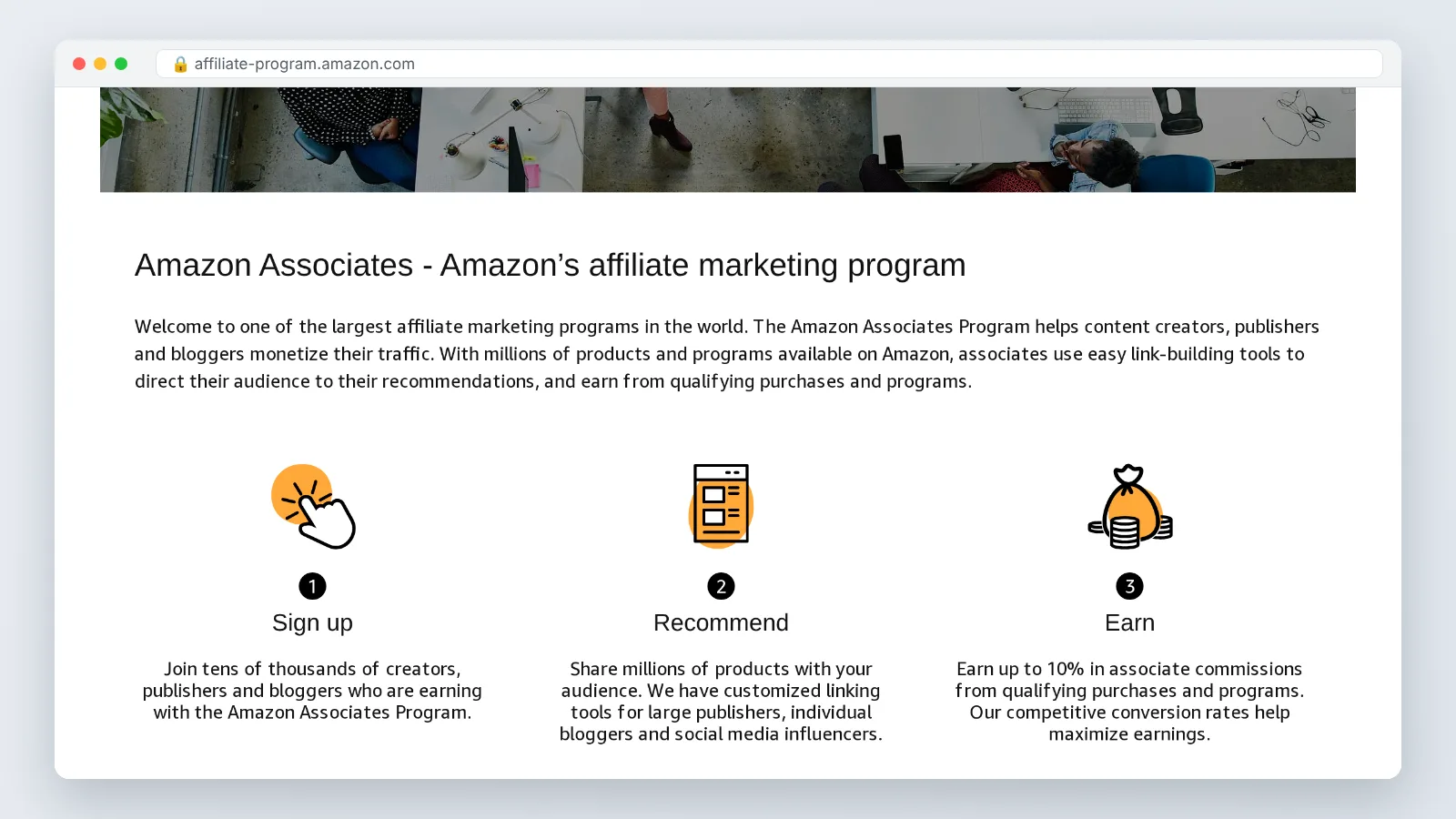
What Is Affiliate Marketing? A Plain-English Definition
Definition: Affiliate marketing is paid referral. A merchant gives you a tracked link, you send a buyer through it, and you earn a commission on the purchase. You hold no inventory and handle no returns.
The arrangement predates the internet. Retailers paid finder’s fees to catalog agents and traveling salespeople long before browsers and cookies existed; software only made the counting automatic and the payout monthly.
Your role is narrow, and that narrowness is the appeal. You help someone decide what to buy, you hand them a link carrying your unique ID, and the merchant owns everything after the click — pricing, checkout, packing, refunds, fraud screening.
The commission comes out of the merchant’s marketing budget, not the shopper’s wallet. Your reader pays the same price they would have paid by typing the store’s address by hand. Honest disclosure therefore costs you nothing and costs them nothing.
What you are actually building is not a pile of links. You are building the thing that happens before the click: a review someone trusts, a comparison that saves an hour of tab-switching, a tutorial that answers the question a product page refuses to answer.
The 3 Players: Merchant, Affiliate, and Customer
Three parties have money or attention at stake in every affiliate sale.
- The merchant (advertiser). Amazon, a software company, a single-product brand. Sets the commission rate, the length of the tracking window, the excluded categories, and the approval rules for your application.
- The affiliate (publisher — you). Supplies the audience and the recommendation. Carries all the traffic risk, gets paid only on outcomes, and owns nothing on the merchant’s side of the transaction.
- The customer. The only person actually spending money. Pays an identical price with or without your link, which is exactly why you owe them the product that fits, not the product that pays most.
A fourth participant usually sits in the room without a stake in the purchase: the tracking platform. Some brands run through networks; Amazon runs its own in-house program, Associates, so your links, reports and payments all come from one dashboard.
Who keeps the customer relationship matters more than beginners expect. The merchant keeps the email address, the order history and every future upsell. You keep the audience that trusted you enough to click, which is the only asset you can take to a different program later.
How Affiliate Marketing Works, Step by Step (Click → Cookie → Commission)
Three mechanical steps sit between a reader and your payout.
Step 1 — The click
You publish a link that contains your tracking ID. A reader clicks it inside a review, a video description or a resource page, and the merchant’s server records which affiliate sent that visitor before the product page finishes loading.
Step 2 — The cookie
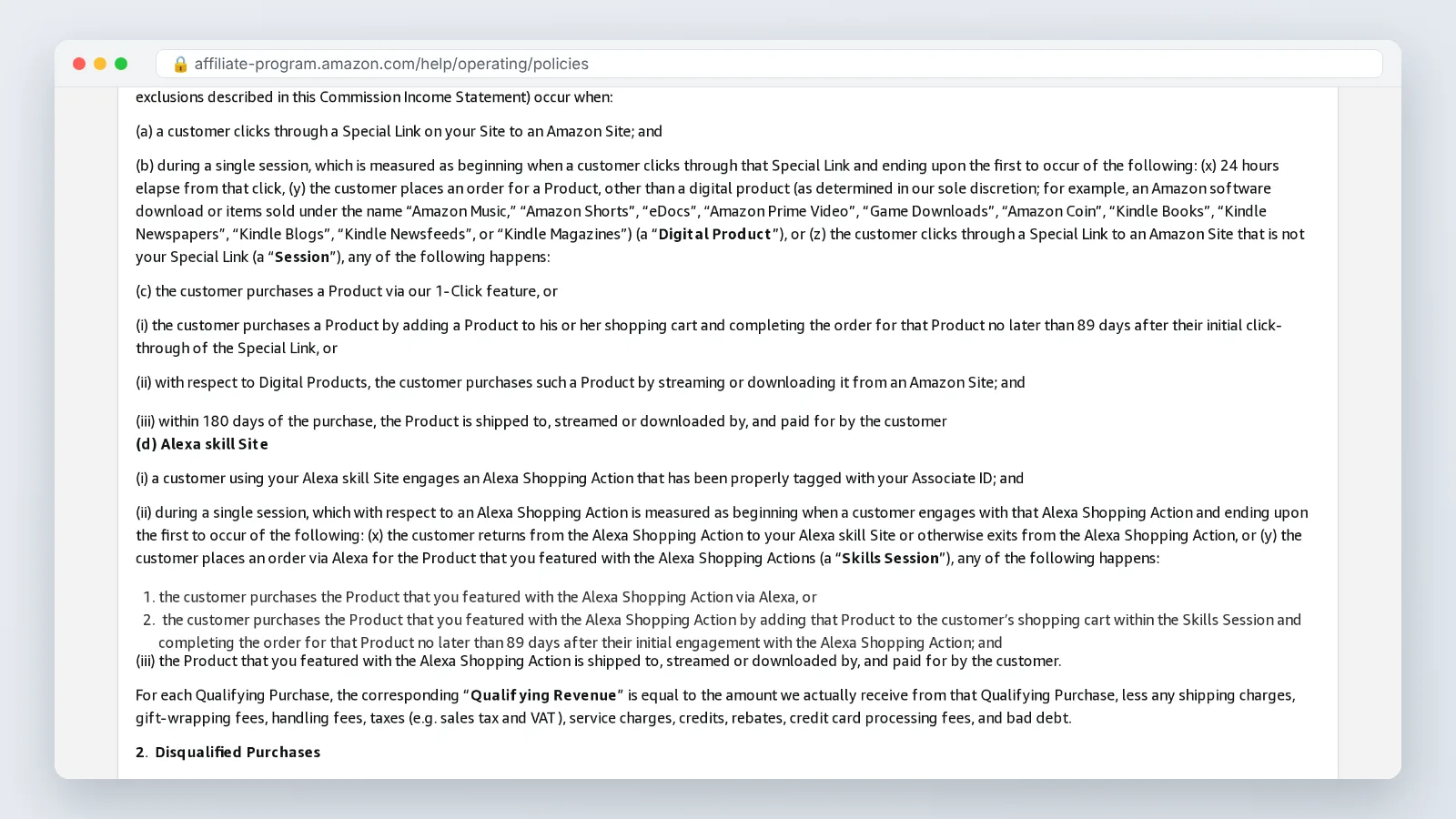
A small file stores your ID in the shopper’s browser for a fixed period. Amazon’s Associates Program Policies define the tracking "Session" as starting at the click on a Special Link and ending when 24 hours elapse from that click, or earlier if the customer orders or clicks another associate’s link.
Carts stretch that logic a little. According to Amazon’s Associates Central help pages, a qualifying item still earns commission income as long as the shopper drops it into the cart during the 24 hours that follow an Associates link bringing them to Amazon.com — and the credit holds if the order goes through before that cart expires, which Amazon says usually happens after 90 days.
Step 3 — The commission
The merchant matches the shipped order to your ID and records an estimated commission. Returns and cancellations get subtracted later, so your dashboard number early in the month is a forecast, not a bank balance.
Short windows change what you should write. A 24-hour window rewards content that meets someone at the decision moment — "best budget espresso machine" — far more than content that merely builds awareness.
How You Actually Get Paid: Commission Rates, Bounties, and Payout Timing
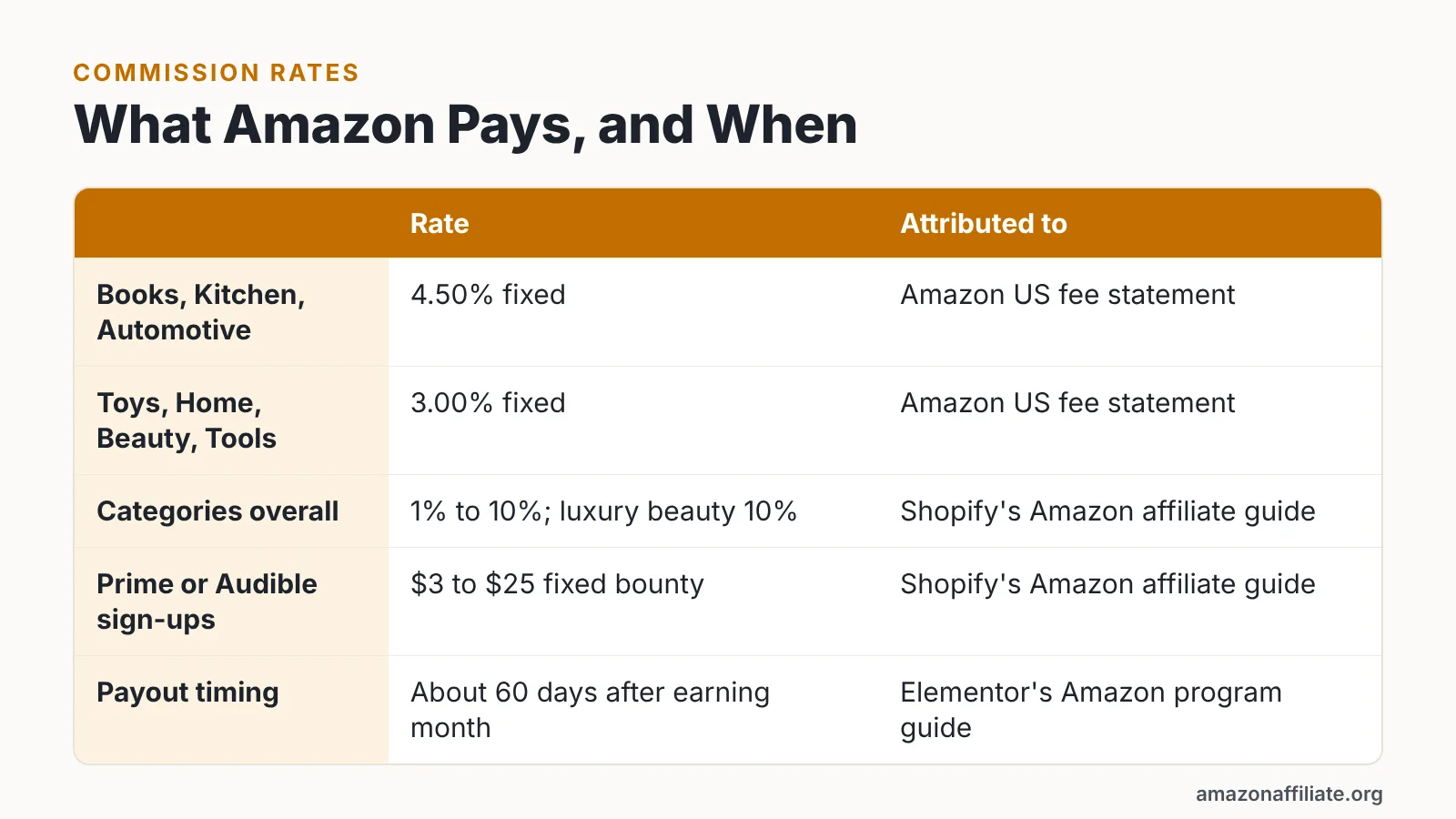
Rates are set by product category, not by how well you write. Amazon’s US Associates fee statement sets a fixed commission income rate of 4.50% for Physical Books, Kitchen and Automotive purchases. The same fee statement pays a fixed 3.00% on Toys, Furniture, Home, Home Improvement, Lawn & Garden, Pets Products, Headphones, Beauty, Outdoors, Tools, Sports and Baby Products.
Shopify’s guide to Amazon affiliate marketing reports that Amazon affiliate commissions run from 1% to 10% by product category, with luxury beauty paying the top 10% rate as of 2025 — those rates were published as of 2025, and Amazon revises the fee statement periodically, so check the current statement before you plan around any single number.
Percentages are not the only payout shape. Shopify’s guide also notes that Amazon’s Bounty program pays fixed fees of $3 to $25 when a referred customer signs up for services such as Prime or Audible, which can beat a small physical-product commission on the same click.
| What you earn on | Rate | Attributed to |
|---|---|---|
| Physical Books, Kitchen, Automotive | 4.50% fixed | Amazon’s US Associates fee statement |
| Toys, Furniture, Home, Home Improvement, Lawn & Garden, Pets, Headphones, Beauty, Outdoors, Tools, Sports, Baby | 3.00% fixed | Amazon’s US Associates fee statement |
| Across product categories overall | 1% to 10%, luxury beauty at 10% as of 2025 (check the current fee statement) | Shopify’s Amazon affiliate marketing guide |
| Service sign-ups such as Prime or Audible | $3 to $25 fixed bounty | Shopify’s Amazon affiliate marketing guide |
Timing is the part that surprises new affiliates. Elementor’s guide to Amazon’s affiliate program reports that earnings are not paid immediately — payouts arrive once a minimum balance is met, roughly 60 days after the month in which the commissions were earned.
Budget around that lag. Content you publish this weekend may not turn into deposited money until two months after it starts converting.
Affiliate Marketing vs. Dropshipping (and Why the Difference Matters for Beginners)
Both models get sold to beginners with the same line: sell without holding inventory. Only one of them makes you the seller.
| Affiliate marketing | Dropshipping | |
|---|---|---|
| Your legal role | Referrer | Seller of record |
| Who sets the price | The merchant | You |
| Who handles refunds and angry emails | The merchant | You |
| Typical startup cost | Program applications are commonly free | Store, supplier samples, ad budget |
| How you earn | Fixed commission rate per category | Margin between supplier cost and your price |
| Main risk | No traffic, no income | Ad spend outrunning margin, shipping delays |
Jungle Scout notes that Amazon Associates is free to join and pays beginners a commission of roughly 1-10% on any sale they generate for Amazon, so the financial downside of starting is your time rather than your savings.
Dropshipping pays better per sale and punishes mistakes harder. A supplier who ships late creates a chargeback against your account, not the brand’s, and you absorb it.
For a complete beginner, the affiliate side is the cheaper classroom. You learn keyword research, product selection and conversion copy without ever touching a refund policy.
Where Beginners Put Affiliate Links: Blogs, Reviews, Videos, and Email
Placement is not decoration. Links convert where a buying decision is already half-made.
- Single-product reviews. Best for people who already know the model name and want a reason to stop researching. Include what you would not recommend it for.
- "Best X for Y" comparisons. The highest-intent format on most affiliate sites, because the reader has narrowed the category and wants a pick.
- Tutorials and how-to posts. Someone learning to proof sourdough will buy the banneton you used mid-recipe, not from a standalone gear roundup.
- Video descriptions and pinned comments. Works when the video demonstrates the product in use; the viewer clicks after they see the thing work.
- A simple resources page. One page listing the tools you actually use, maintained quarterly, keeps earning without new content.
Email deserves caution rather than enthusiasm. Amazon’s Associates Program Policies restrict where Special Links may be placed, so read the current policy before pasting them into a newsletter, a PDF or an offline document — the safe pattern is linking to your own post and letting the post carry the affiliate link.
Use separate tracking IDs per placement. Knowing that your YouTube description outperforms your homepage changes where you spend next month.
How to Join Your First Affiliate Program in a Weekend
Saturday morning: pick a niche from your own receipts. Choose a category where you already own three or four products, where buyers compare before purchasing, and where the price point justifies a small percentage.
Saturday afternoon: get the site presentable and apply. Most programs, Amazon Associates included, want to see real published content, a working About page and clear contact details before approval, so publish two or three genuine posts first.
Sunday morning: write one comparison article targeting a specific buyer, not a broad category. "Best cordless vacuum for apartments with pets" beats "best vacuums" because you can give one clear recommendation and defend it.
Sunday afternoon: build your links, add a disclosure above the first link, and create distinct tracking IDs for your blog, your email list and your video channel.
Keep the weekend scope ruthless. One niche, one program, one article, one disclosure block — and a calendar note to check your reports in 30 days rather than every evening.
Approval conditions are set by the program and can change, so confirm the current approval terms in the program’s own documentation before you count on anything.
Beginner Mistakes, Disclosure Rules, and Realistic Expectations
The common failures are predictable:
- Choosing a niche by commission rate instead of by what you can write credibly about.
- Publishing reviews of products nobody is searching for.
- Dropping twelve links into a 600-word post, which reads like a pitch and converts worse than two well-placed ones.
- Treating estimated earnings as final before the return window closes.
Disclosure is not optional. In the United States, the Federal Trade Commission’s endorsement guides require that a material connection — an affiliate commission counts — be disclosed clearly and near the recommendation, not buried in a footer. Rules differ by jurisdiction: UK advertising rules and EU consumer protection law set their own standards, and Amazon’s program policies impose disclosure obligations on participants on top of whatever the local law demands.
Program mechanics also differ by country, which trips up affiliates who read one help page and assume it applies everywhere. Amazon’s India Associates Operating Agreement requires the referred order to be placed no later than 89 days after the initial click-through, a materially different attribution rule from the US session described earlier.
Expect a slow first quarter. Search traffic compounds, affiliate reporting lags, and payouts lag again — so judge your first article on whether it ranks and gets clicked, not on whether it paid for your coffee.
This article is general information, not legal or financial advice; check current program terms and the advertising rules that apply in your own jurisdiction.
Frequently asked questions
How long does an Amazon affiliate cookie last?
Amazon’s Associates Program Policies define the tracking session as starting at the click on a Special Link and ending when 24 hours elapse, or earlier if the customer orders or clicks another associate’s link. If the item sits in the cart, Amazon credits the commission when the order is placed before the cart expires, usually after 90 days.
How much does a beginner affiliate actually earn per sale?
It depends entirely on the category. Amazon’s US Associates fee statement sets a fixed 4.50% rate on Physical Books, Kitchen and Automotive, and a fixed 3.00% on Toys, Home, Beauty, Tools and Baby Products. Shopify’s guide reports commissions ranging from 1% to 10%, with luxury beauty at the top 10% rate as of 2025 — those rates were published as of 2025, and Amazon revises the fee statement periodically, so check the current statement.
When does the money actually reach my bank account?
Not quickly. Elementor’s guide to Amazon’s affiliate program reports that payouts arrive once a minimum balance is met, roughly 60 days after the month in which the commissions were earned. Plan cash flow around that gap, and remember that returns are deducted before anything is finalized.
Do I need a website to start affiliate marketing?
You need a place where you publish real content and where a program can review you — a blog, a YouTube channel, or both. A site you control is the safer base, because platform rule changes cannot delete your archive, and most programs want to see several published pieces plus working About and contact pages before approval.
Is affiliate marketing the same as dropshipping?
No. Dropshipping makes you the seller of record, so you set prices, absorb refunds and field complaints about shipping delays. Affiliate marketing keeps you a referrer: Jungle Scout notes Amazon Associates is free to join and pays beginners roughly 1-10% commission on sales they generate, with the merchant handling fulfillment and returns.
Sources
- Associates Program Standard Commission Income Statement — Amazon.com Associates Central
- Associates Program Policies — Amazon.com Associates Central
- Amazon.com Associates Central — Help (Shopping Cart and commission window)
- Amazon.in Associates Central – Associates Program Operating Agreement
- Amazon Affiliate Marketing: How It Works (Shopify Blog)
- How to Make Money as an Amazon Affiliate in 2024 — Jungle Scout
- Everything You Need to Know About Amazon’s Affiliate Program — Elementor
Written with AI assistance and fact-checked against the sources cited above before the Amazon Affiliate Editorial Team published it.